
Subtotal $0.00


111
Real Madrid edge Barcelona to extend La Liga lead
Match context and result
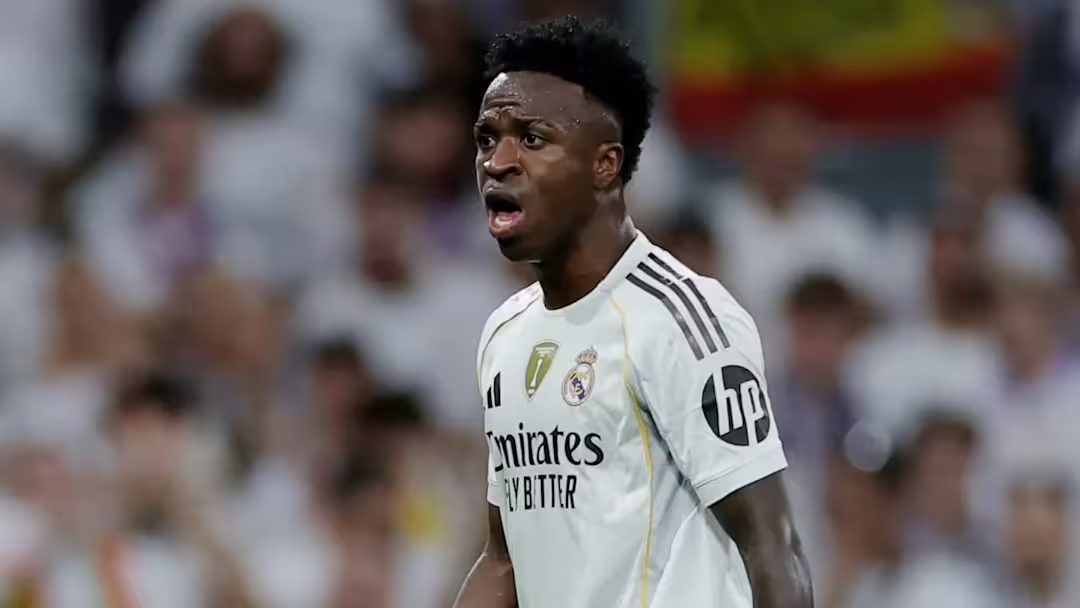
Real Madrid edged Barcelona in a pulsating Clasico, a result that could push them five points clear at the top of La Liga and intensify the title race. The victory was built on disciplined defending, a measured midfield and a decisive finish that kept Madrid in control of the league standings. Yet the turnaround moment that dominated the narrative was not the goal, but the reaction on the sideline. The Vinicius substitution controversy overshadowed the triumph as dynamic winger Vinicius Junior reacted angrily to being withdrawn by coach Xabi Alonso. The scene sparked a flame of debate about emotion, professionalism, and the boundaries between a player’s passion and the manager’s authority. For readers seeking broader coverage, see the match report at BBC Sport and the club’s own recap at Real Madrid TV.
The result alone would have kept Real Madrid on track for a sustained title challenge, but the Vinicius substitution controversy added a dramatic subplot that will be shelved in the immediate post-match notes and reopened in the coming days. Alonso will be judged on results and rhythm, yet the incident raises questions about communication, leadership, and the evolving relationship between star players and a coach tasked with balancing short-term rewards with long-term strategy. The Vinicius substitution controversy is now part of the club’s ongoing narrative as it seeks to convert a big win into a durable advantage in La Liga.
- Impact on Los Blancos’ rotation policy ahead of upcoming fixtures
- Potential strain or growth in Vinicius’ on-field leadership
- How Alonso communicates substitutions in high-pressure games
Vinicius Junior’s substitution sparks controversy
The moment and the message
The Vinicius substitution controversy unfolded late in the second half as Alonso signaled for a change. Video footage showed Vinicius reacting with visible frustration, turning toward the bench and gesturing while leaving the pitch. The intensity of his response sparked a heated discussion among supporters and pundits about whether such displays are compatible with elite-level professionalism. There was no official statement from the club immediately after the final whistle, which left fans and analysts to interpret the moment through social media clips, press conference snippets, and the players’ prior history with the manager. The Vinicius substitution controversy quickly became the talking point, overshadowing what was otherwise a strong team performance.
The enduring question is whether this outburst signals a deeper disconnect or simply a momentary spark in a high-stakes environment. Alonso’s substitution strategy appears consistent with a plan to keep the team competitive across a busy schedule, but the optics of Vinicius’s response will be examined in detail. Will this episode force a recalibration of how substitutions are communicated to the players, or will it simply be filed as an emblematic instance of a player’s competitive fire? The Vinicius substitution controversy will likely inform the discussion on leadership and the balance between emotion and restraint in the squad’s dynamics.
Dugarry’s critique: ‘whines all the time’ and ‘insults’ the coach
Contemporary debate on player conduct and leadership
Christophe Dugarry joined a chorus of critics, describing Vinicius as someone who “whines all the time” and accusing the winger of “insulting” the coach through his actions and reactions. Dugarry argued that players must back the manager’s decisions, respect the hierarchy, and demonstrate composure in high-pressure moments. His comments add a sharp, provocative edge to a broader discussion about how star players should conduct themselves when the heat is on and results hinge on every decision. The Vinicius substitution controversy has become a case study in how public figures respond to discipline and how coaches navigate the line between empathy and command.
Supporters of Vinicius counter that passion is part of his identity and that his intensity has often driven Real Madrid’s big results. The debate is less about one moment and more about a culture: how teams channel emotion into performance, how managers channel it into discipline, and what the boundaries are in a modern dressing room. Dugarry’s stance intensifies the discussion, but the conversation continues to reflect on whether leadership in elite football should permit visible dissent in moments of substitution or insist on unwavering public deference to the coach. Vinicius substitution controversy thus becomes a litmus test for leadership philosophy at a club chasing consistency across competitions.
Impact on Real Madrid and Vinicius going forward
Consequences for strategy and relationships in Madrid
The Vinicius substitution controversy could alter the dynamics inside Real Madrid’s squad. In practical terms, Alonso might reassess how he communicates substitutions to high-profile players, seeking a balance between maintaining momentum and preserving harmony. For Vinicius, this moment offers a chance to demonstrate leadership through controlled emotion, improving on-court decision-making and his relationship with the coaching staff. The immediate impact may be tactical: more explicit substitution routines, clarified expectations, and perhaps a short-term adjustment in Vinicius’ playing time to preserve energy for crucial fixtures. If managed well, the episode could strengthen Madrid’s resilience as they push for a sustainable lead in La Liga.
Longer term, the Vinicius substitution controversy might influence how the club develops its next generation of attacking talent. The ability to support star players while keeping a unified dressing room will be central to Madrid’s pursuit of trophies across competitions. Alonso’s approach to handling substitutions could become a model if the team translates a strong win into consistency over the season. The key will be communication, trust, and a shared sense of purpose that drives the team forward without eroding individual motivation.
Pundit and fan reactions
Public sentiment and what it means for Madrid
Across punditry and social media, reactions to the Vinicius substitution controversy have been mixed, with some praising Vinicius’s competitive spirit and others urging greater restraint. Many observers argue that a player who operates at Vinicius’ level should model composure, especially in front of a global audience, while others maintain that genuine emotion is part of what makes him special and effective. The discussion around this moment reflects broader debates about the responsibilities of star players, the authority of coaches, and how teams balance personality with discipline. As Real Madrid continues their campaign, the focus will be on how fans and media interpret leadership under pressure and how Vinicius progresses in his relationship with Alonso and the rest of the squad.
In the coming weeks, supporters will watch for how Madrid translates one dramatic night into sustained performance. Engagement on forums and social channels shows a club widely scrutinized for every decision, where a single substitution can become a defining storyline for the season. The Vinicius substitution controversy will be part of the club’s narrative as they pursue a long-term La Liga title and deep runs in Europe. For readers seeking ongoing updates, follow official club communications and trusted outlets like BBC Sport and ESPN FC.